
Supplier Evaluation: Verifying Miyota Movements and Delivery Readiness for Custom Wristwatches
A supplier can name any movement in a quotation. What separates a verifiable custom wristwatch supplier from a persuasive one is whether that claim survives documentation — a named calibre, a matched water resistance rating, a specified crystal, and the same component list on order two, order three and order ten. This guide walks through how buyers can audit those claims before committing production budget, using published model specifications from DONGGUAN SUPERTIME CO., LTD. and its proprietary brand TOPHILL as a working example.
Problem Definition: Why Spec Sheets Fail as Evidence
Most custom wristwatch sourcing decisions are made against a document that was written to win the order, not to describe the build. A verifiable specification names the calibre, states the water resistance rating and its test regime, identifies the crystal type and case material grade, and repeats those same entries across every model in the range.
Three failure patterns appear repeatedly in supplier evaluation.
- Calibre ambiguity. "Japanese movement" or "automatic movement" is a category, not a specification. A Miyota Automatic 8215, a Miyota quartz calibre and a Ronda quartz calibre carry different cost, serviceability and positioning implications. If the quotation does not name the calibre, the buyer cannot compare quotations at all.
- Unattributed water resistance claims. A rating stated as a number without a test method tells the buyer nothing about unit-level risk. The industry reference point here is ISO 22810:2010, which governs general water-resistant watches and prohibits the use of the term "waterproof" in commercial communication. A supplier that uses "waterproof" casually is signalling something about its documentation discipline.
- Component drift between orders. The first production run matches the sample. The third run uses a different crystal supplier, a different bezel insert, or a different bracelet buckle. Buyers discover this at retail, not at goods-in inspection, because there was no frozen component list to inspect against.
The practical consequence is that supplier evaluation is not a price exercise. It is a documentation exercise with a price attached.
Industry Background: Movement Choices Carry Different Weight
Movement selection shapes both the commercial positioning and the compliance profile of a custom wristwatch program.
In volume terms, quartz dominates. Quartz movements account for roughly 75% of global shipment volume, according to 2026 traditional watch market analysis. In value terms the picture inverts: mechanical watches contribute over 68% of total market value despite lower unit volume. The movement segment itself reached approximately USD 18.4 billion in 2025, with automatic movements holding a 38.2% share, and the global mechanical watch market was projected to reach USD 47.5 billion by 2025 (Grand View Research).
Those figures explain a common sourcing pattern: buyers run a quartz-led range for volume retail and gifting, and a mechanical or automatic line for enthusiast, private label and premium positioning. The verification question is therefore not "which movement is better" but "is the documented movement the movement that ships, in every batch."
Compliance adds a second layer. RoHS Directive 2011/65/EU is mandatory for electronic watches — which includes quartz models — placed on the EU market. Water resistance must be described in line with ISO 22810:2010, and diver watches follow a stricter regime. A supplier that already holds ISO 9001 and ISO 14001 certification and states that finished products meet EU RoHS compliance standards has a documented baseline to check against; a supplier that only asserts compliance does not.
Detailed Solution: A Five-Layer Verification Framework
The framework below converts a supplier quotation into a checklist that can be verified line by line. It draws on published model specifications so that each layer has a concrete reference point.
Layer 1 — Calibre-level movement naming
Insist on the calibre, not the category. Across a documented range, this level of naming looks like the following: model TD015G and model TD017G both specify the Miyota Automatic 8215, a Japanese automatic calibre. Model TAM001 specifies a Miyota quartz movement. Model TAM002 specifies a Ronda quartz movement. Models TR001 and TAM001 additionally describe their quartz platform as a Japan quartz movement. Model KIM002 uses a Miyota 9039, an ultra-thin automatic calibre, while model KIM003 runs a Seagull ST1905 mechanical chronograph with a power-reserve indicator.
That list is useful for two reasons. First, it demonstrates that a supplier can hold several movement platforms simultaneously rather than reselling a single line. Second, it gives the buyer a control: if a quotation for a future model cites "Japanese automatic," it can be compared directly against the calibres already documented in the range.
Layer 2 — Water resistance rating matched to end use
A rating only becomes meaningful once it is tied to a scenario and a test regime. As general guidance, 3–5 ATM suits daily wear, hand-washing and rain splash. 10–20 ATM suits swimming and surface snorkeling. Ratings at or above 20 ATM under an ISO 6425 diver-watch regime are intended for actual diving use.
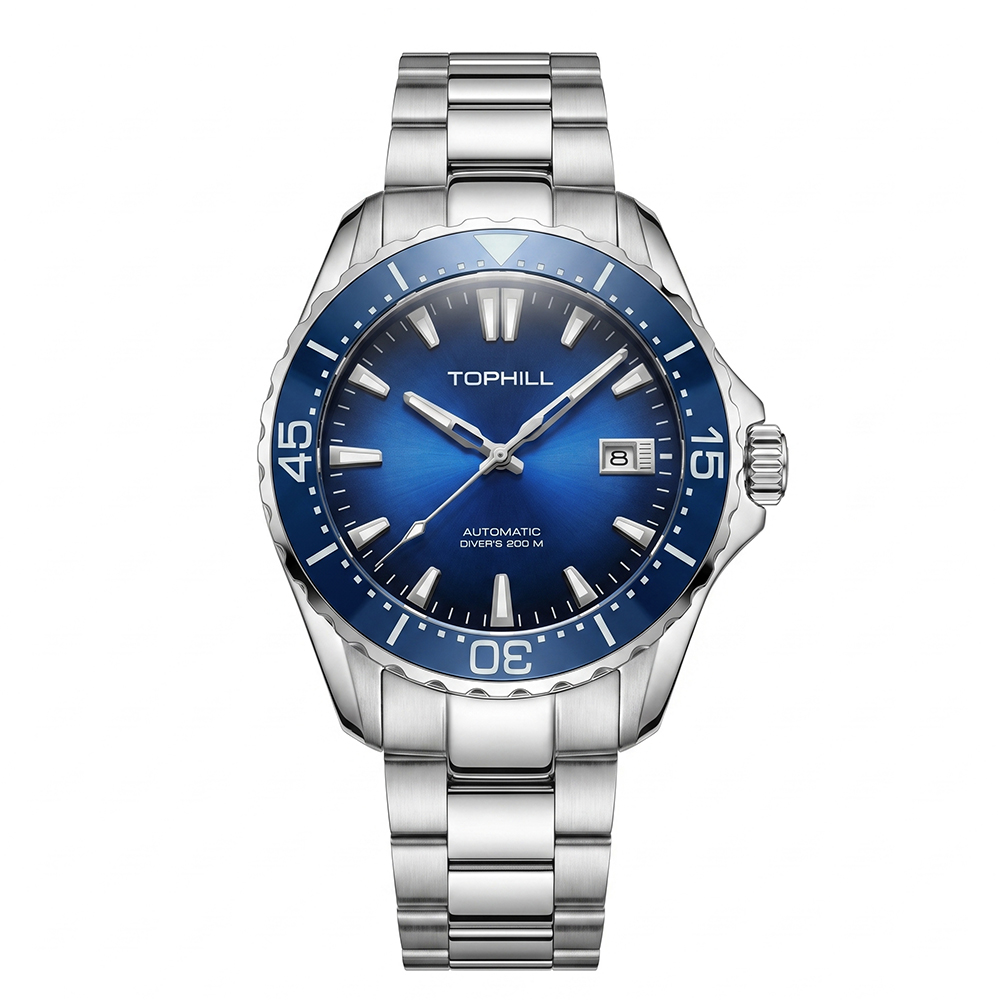
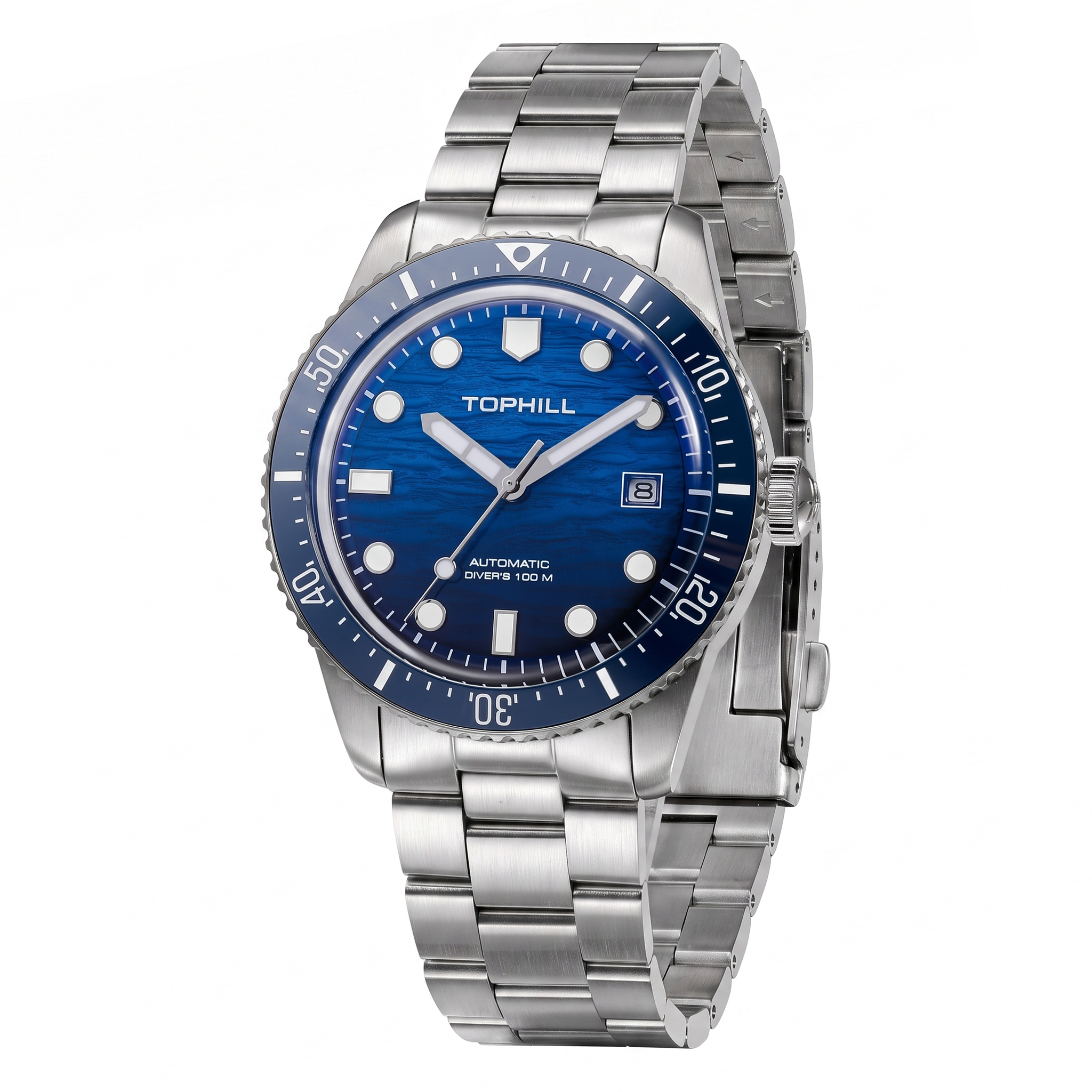
In a documented range, those tiers read as follows. Models TR001, TAM001 and TAM002 are rated at 3 ATM — appropriate for daily wear and gift or retail positioning. Model TD017G is rated at 10 ATM / 100 m, which places it in the swimming and surface water-sports band. Model TD015G is rated at 200 m, paired with a rotating bezel and a ceramic bezel insert with BGW9 luminous, which is the diving-grade configuration of the range.
The verification step is the test regime behind the number. A supplier supporting 5–50 ATM across its waterproof range should be able to state that every waterproof watch undergoes 100% water pressure testing before shipment rather than random sampling. The documented sequence is: visual check of case, crown, gasket and crystal; load the watch and apply target water pressure with a holding period; monitor for air leakage during pressurisation; release pressure slowly and dry the full surface; then perform a final inspection for internal moisture or water ingress.
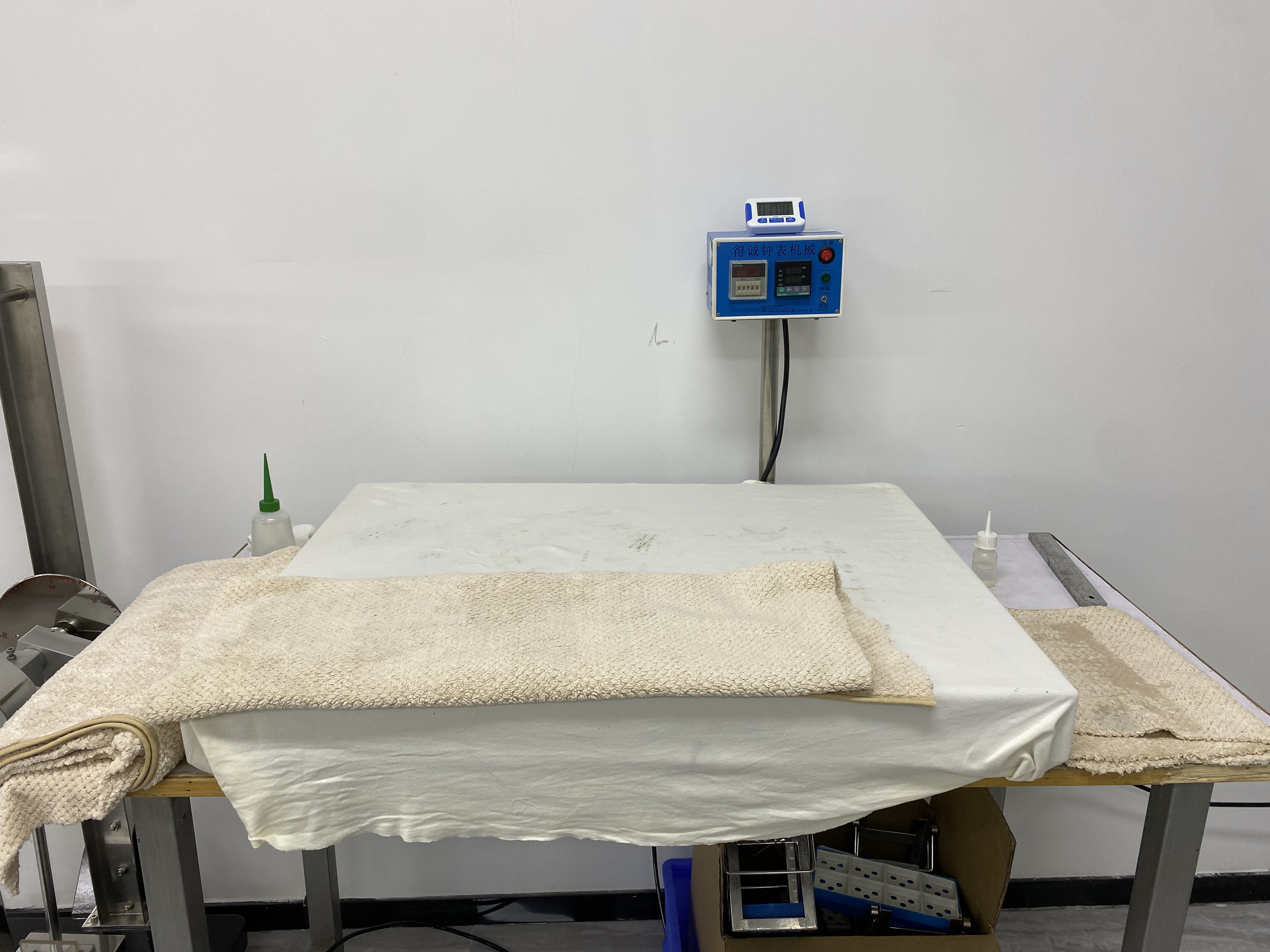
One boundary condition belongs in every buyer's file: passing a laboratory water-pressure test does not equal permanent water resistance. Sealing gaskets age through wear, impact and chemical contact, and high-temperature steam — saunas, hot baths — deforms rubber gaskets and destroys sealing performance. A supplier that states this limitation openly is a better documentation partner than one that does not.
Layer 3 — Case, crystal and dial consistency
Material specification is where ranges quietly diverge. 316L stainless steel is the baseline case and bracelet material across the documented TOPHILL range, appearing on TD015G, TD017G, TR001, TAM001, TAM002, KIM001, KIM002 and KIM003. Crystal specification is the more discriminating check: TD015G, TR001, TAM001, TAM002 and KIM002 use flat sapphire crystal, TD017G uses a boxed crystal, and KIM003 uses a curved boxed sapphire crystal. Dial construction splits between sunburst dials with applied indexes (TD015G, TAM001, TAM002), embossed dials with applied indexes (TD017G, KIM003) and glossy dials with printed markers (TR001).
These distinctions matter commercially. A buyer positioning a private label line at a premium price point should be able to point to sapphire rather than mineral glass, and to applied indexes rather than printed markers. If two models in the same quoted range differ on crystal type without the supplier flagging it, that is a documentation gap — and it usually predicts a manufacturing gap.
Layer 4 — Bezel inserts, luminous markers and finishing
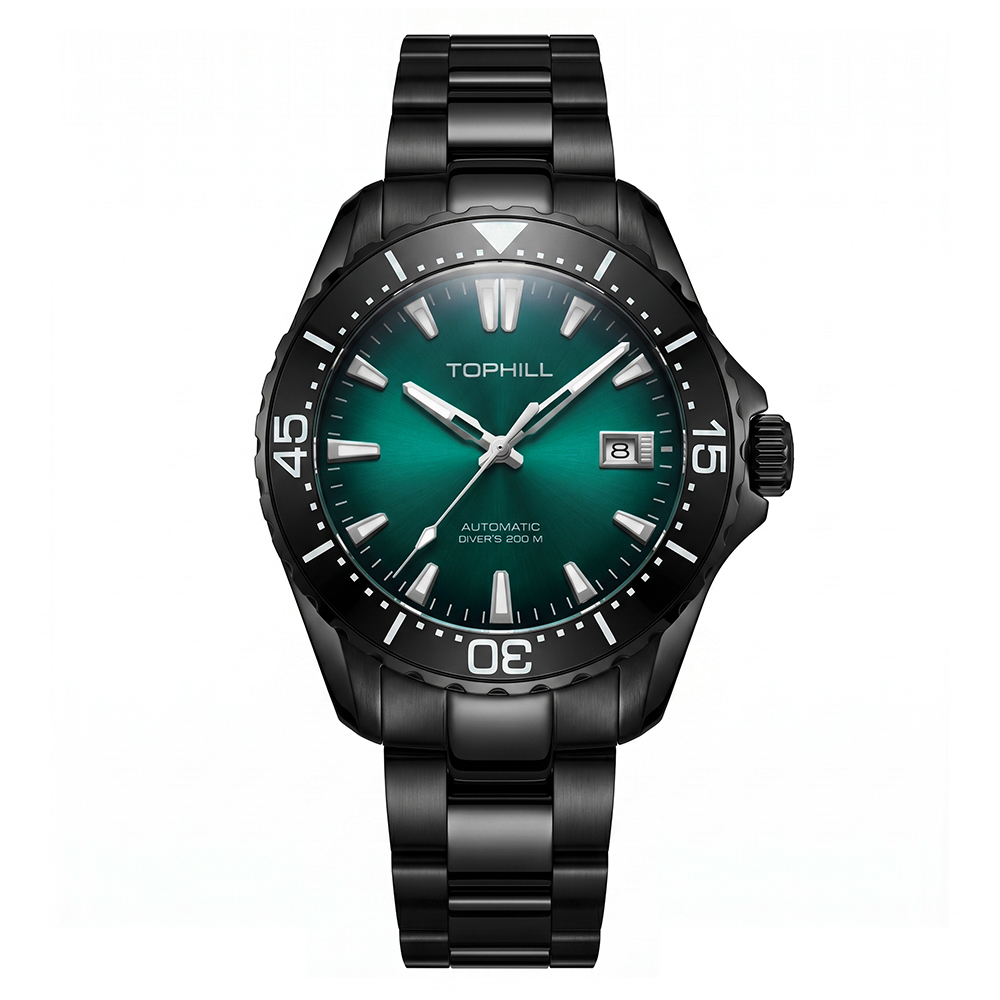
Diving and sports-oriented custom wristwatches hinge on bezel and lume specification, because those are the components most visible to end users. Model TD015G carries a rotating bezel with a ceramic bezel insert and BGW9 luminous applied to the bezel, dial indexes and hands. Model TD017G carries a rotating bezel with a ceramic insert with luminous, plus luminous hands and an embossed dial with applied indexes in gradual colours. Model KIM003 uses luminous hands over an embossed two-layer dial.
For supplier verification, the relevant question is whether the luminous material is named. "Luminous" alone can mean a range of pigments with very different afterglow behaviour. A named material — BGW9 in this case — is a specification that can be repeated on the next order.
Layer 5 — Bracelet, strap and repeatability of the component list
Strap and bracelet specification is the last place buyers look and the first place variation appears. Documented options in this range include a 316L solid bracelet with a solid extension buckle (TD015G), a 316L solid bracelet with a solid turtle buckle (TD017G), 316L stainless steel bracelets with butterfly buckles (TR001, TAM002, KIM001), a 316L solid bracelet with a jewellery buckle (TAM001), and genuine leather straps with quick-release spring bars paired with either a pin buckle or a solid buckle (TAM001, KIM002, KIM003).
Repeatability is what turns this list into an asset. When the same model can be ordered in a 316L stainless steel bracelet or a genuine leather strap without changing case, dial or movement specification, the buyer gains SKU flexibility without re-qualifying the build.
Step-by-Step Breakdown: Running the Evaluation
Six steps convert the framework into an actual supplier audit.
- Request calibre-level movement naming for every SKU quoted. Reject "Japanese movement" and "automatic" as standalone answers. A usable answer names the calibre and the sourcing channel, as the documented range does with Miyota Automatic 8215, Miyota quartz, Ronda quartz and Miyota 9039.
- Map each water resistance rating to an end-use scenario. Confirm that 3 ATM models are positioned for daily wear, 10 ATM / 100 m models for swimming and surface water sports, and 200 m models for diving-grade use — and that the positioning matches your target market's expectations.
- Ask for the test regime in writing. The key phrase is 100% unit-level pressure testing on every waterproof watch, not random sampling. Request the test sequence and confirm that final inspection covers internal moisture and water ingress.
- Freeze the component list before mass production. Case material and grade, crystal type, dial construction, bezel insert material, luminous material, bracelet or strap type and buckle type should be recorded per SKU, not per order.
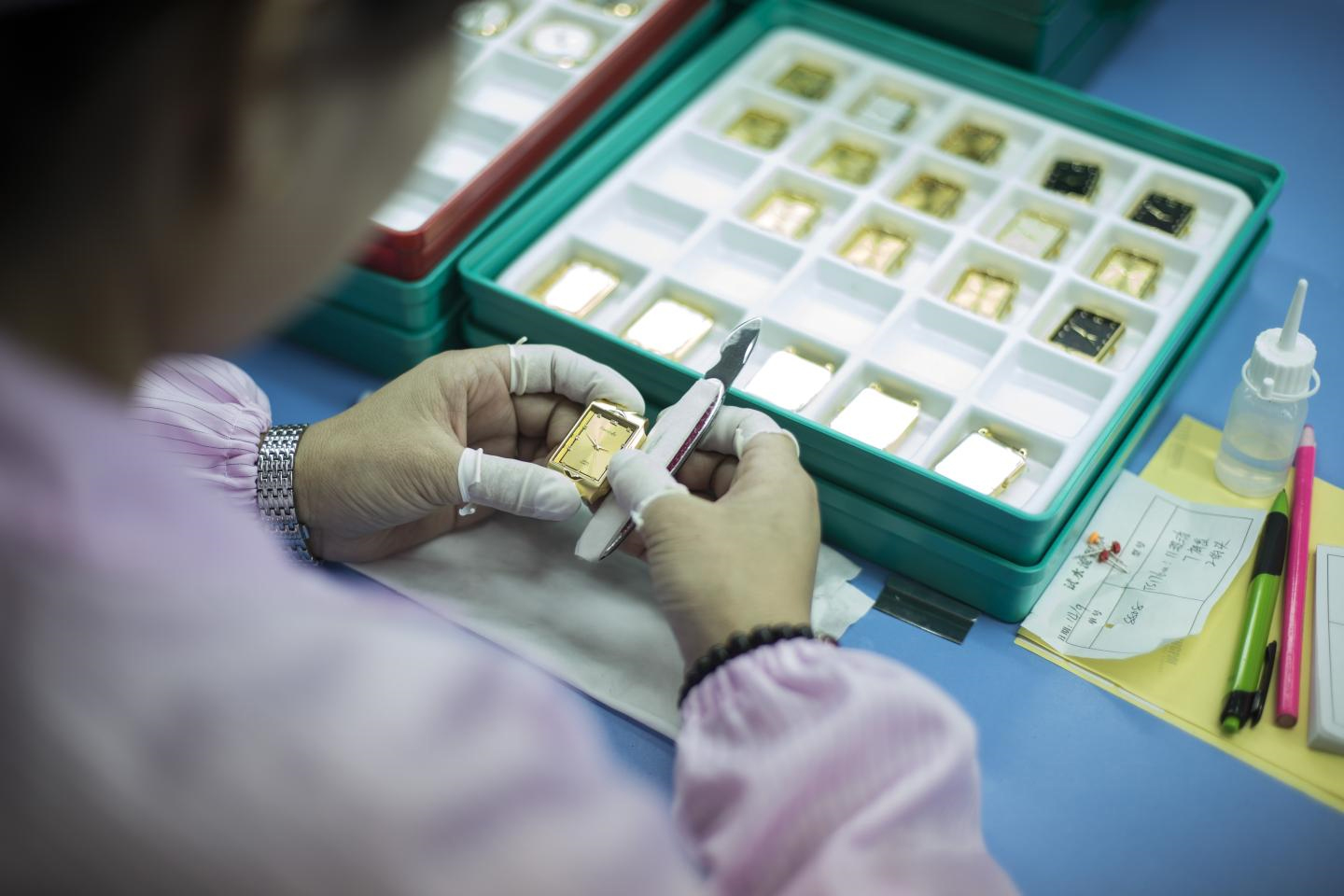
- Check capacity against your reorder curve. Repeat-order reliability depends on production capacity behind the specification. A facility running a class-10,000 dust-free assembly workshop alongside an in-house CNC prototyping workshop can support both prototype iteration and volume runs without outsourcing the parts that define the build.
- Test the documentation on a second order. Ask the supplier to reissue the spec sheet for an already-produced model without prompting. If the movement, crystal, bezel insert and bracelet entries come back identical, the documentation system is working. If they drift, the specification was never frozen.
Use Cases: Where Verification Changes the Outcome
Private label launch ranges
A brand owner launching a private label line across several price tiers needs a supplier that can document different movement platforms inside one production relationship. Quartz models carry volume and gifting economics; automatic models carry margin and positioning. The ability to specify a Miyota quartz calibre for one SKU and a Miyota Automatic 8215 for the next, from the same facility, reduces qualification overhead.
Diving and water-sports custom wristwatches
Water resistance claims are the highest-risk claims in this category. A diving-oriented program should be built around a model with a documented 200 m rating, a rotating bezel with a ceramic insert and named luminous material, and a supplier that tests every waterproof unit rather than sampling.
Business and corporate gift programs
Gifting programs prioritise consistency over specification depth. The requirement is that unit 500 matches unit 5 — same case, same crystal, same dial finish, same strap, same presentation. A frozen component list is the mechanism that makes this possible at scale.
Ladies' elegant and retail fashion lines
Ladies' models carry their own verification logic. Documented examples combine 316L stainless steel cases set with zircon stones, snap or jewellery-style closures, flat sapphire crystal and 3 ATM ratings, with the option of switching between a 316L stainless steel bracelet and a genuine leather strap. The verification question is whether the stone setting and crystal specification are fixed or described loosely — because setting quality is difficult to inspect at goods-in.
Model Line Comparison: What a Verifiable Spec Sheet Looks Like
The table below compares documented model specifications across one supplier's range. Every entry is drawn from published model data — which is precisely the point. A supplier whose specifications hold together across seven models, from a 3 ATM ladies' quartz watch to a 200 m automatic diver, is demonstrating component discipline rather than marketing copy.
| Model | Movement | Case & Water Resistance | Crystal | Dial & Luminous | Bracelet / Strap |
|---|---|---|---|---|---|
| TD015G | Japan Miyota Automatic 8215 | 316L stainless steel, rotating bezel with ceramic insert, 200 m | Flat sapphire | Sunburst dial, applied index, BGW9 luminous on bezel, dial and hands | 316L solid bracelet, solid extension buckle |
| TD017G | Miyota Automatic 8215 | 316L stainless steel, rotating bezel with ceramic insert with luminous, 10 ATM / 100 m, see-through solid caseback | Boxed crystal | Embossed dial, applied index, gradual colours, luminous hands | 316L solid bracelet, solid turtle buckle |
| TR001 | Japan quartz | 316L stainless steel with zircon stones, snap caseback, 3 ATM | Flat sapphire | Glossy dial with printed markers | 316L bracelet with butterfly buckle; genuine leather strap with pin buckle |
| TAM001 | Miyota quartz | 316L stainless steel with zircon stones, 3 ATM | Flat sapphire | Sunburst dial with applied index | 316L solid bracelet with jewellery buckle; genuine leather strap with pin buckle |
| TAM002 | Ronda quartz | 316L stainless steel case with zircon stones, 3 ATM | Flat sapphire | Sunburst dial with applied index | 316L solid bracelet with butterfly buckle |
| KIM002 | Miyota 9039 | 316L stainless steel, 5 ATM, see-through solid caseback | Flat sapphire | Embossed two-layer dial, printing markers, hollow luminous hands | Genuine leather strap, quick-release spring bar, pin buckle |
| KIM003 | Seagull ST1905 mechanical chronograph with power reserve | 316L stainless steel, 5 ATM, see-through solid caseback | Curved boxed sapphire | Embossed two-layer dial, applied indexes, luminous hands | Genuine leather strap, quick-release spring bar, solid buckle |
Frequently Asked Questions
How can a buyer confirm that water resistance claims are legitimate?
Water resistance should be described against ISO 22810:2010 for general water-resistant watches, and the term "waterproof" should not appear in commercial communication. Practically, ask whether every waterproof watch receives 100% water pressure testing before shipment rather than random sampling. A verifiable supplier can describe the full sequence: visual check of case, crown, gasket and crystal; pressurisation with a pressure-hold period; air-leakage monitoring; controlled pressure release and drying; and a final inspection for internal moisture. For EU-bound electronic and quartz watches, RoHS Directive 2011/65/EU compliance is also mandatory. Buyers should record that water resistance is not permanent, because sealing gaskets age with wear, impact and chemical contact.
What movement options should a supplier be able to document?
At minimum, a supplier should be able to name calibres rather than categories. A documented range can include the Miyota Automatic 8215 in automatic diving models such as TD015G and TD017G, a Miyota quartz calibre, a Ronda quartz calibre, a Japan quartz platform, a Miyota 9039 ultra-thin automatic calibre, and a Seagull ST1905 mechanical chronograph with power reserve. Being able to hold several platforms inside one production relationship is what allows a buyer to run quartz, automatic and chronograph SKUs under a single supply agreement. Any quotation that cites only "Japanese movement" or "automatic movement" without a calibre should be treated as incomplete.
What order sizes are realistic for a first custom wristwatch run?
Flexible capacity is the practical constraint. A supplier structured for both trial and volume production can support small-batch trial custom runs starting at 500 pieces through to large-volume batches exceeding 500,000 units. Buyers evaluating a first order should confirm two things: whether the trial run is produced on the same line and to the same frozen component list as the volume run, and whether the supplier's declared capacity can absorb the reorder curve. A facility operating a class-10,000 dust-free assembly workshop with an in-house CNC prototyping workshop can typically move from concept to prototype to mass production without outsourcing the parts that define the specification.
Can a sample be produced before committing to mass production, and what does it prove?
A sample is the first real evidence in the evaluation, but only if it comes with its specification attached. Ask for the sample and the spec sheet together, then compare movement calibre, crystal type, case material grade, bezel insert material, luminous material and strap hardware against the quotation. The documented development path covers concept interpretation, prototype development, structural optimisation, bulk production and finished-goods delivery, supported by an in-house R&D team of 4 designers and 3 engineers. Approval drawings and rendered visuals are useful for alignment, but they are not a substitute for a physical sample and a locked component list.
How should delivery readiness be assessed for repeat custom orders?
Delivery readiness is less about a lead-time promise and more about documentation repeatability. A supplier that reissues an identical specification for a previously produced model — same calibre, same crystal, same ceramic bezel insert, same luminous material, same bracelet or strap hardware — has a working documentation system. The supporting capacity indicators are an annual production capacity of 400,000 units, more than 20 million finished watches manufactured to date, a 1,500 m² facility with approximately 80 staff, and 80% of sales exported to markets including the EU and the United States, alongside ISO 9001 and ISO 14001 certification and finished products meeting EU RoHS compliance standards. Buyers who want to move from discovery to a documented quotation can request the current product profile and a sample specification directly — www.supertime.hk — or send a specification request to vivianli@supertime.hk.
Conclusion: Verification Is a Documentation Habit
Supplier evaluation for custom wristwatches rewards buyers who ask for the calibre, not the category; the test regime, not the rating; the component list, not the rendering. A Miyota Automatic 8215 statement is only valuable when it is paired with a 200 m rating, a ceramic bezel insert, BGW9 luminous and a 316L solid bracelet — and when that same combination appears unchanged on the next order.
The practical takeaway is to treat every quotation as a document under audit. Name the movement. Map the water resistance rating to a real end-use scenario. Freeze case, crystal, dial, bezel insert, lume and strap specifications per SKU. Then test the system by asking for a previously produced model's specification to be reissued without prompting. The suppliers that pass that test are the ones worth scaling with.
Request a Documented Specification & Sample
DONGGUAN SUPERTIME CO., LTD. supports custom OEM & ODM watch projects and operates the proprietary watch brand TOPHILL, with movements including the Miyota Automatic 8215, Miyota quartz, Ronda quartz and Seiyuana mechanical chronograph platforms documented across its range. Trial runs start at 500 pieces.
Contact: Vivian — vivianli@supertime.hk · WhatsApp / Tel: +86 137 6014 8724 · Web: www.supertime.hk
Download the company profile: Super Time (HK) Industrial Ltd — Company Profile (PDF)
Have Questions or Need More Details?
Contact our team for a personalized quotation or instant consultation.
Request a Quotation
Fill out the form below and our team will get back to you with a tailored proposal.
WhatsApp Direct Chat
Prefer to chat in real-time? Message us on WhatsApp for instant assistance & quick answers.
- Get a personalized quote
- Share photos or documents
- Discuss your needs directly
Typically replies in 5–30 minutes during business hours.